




SLS School Banner

SLS School Banner

SLS

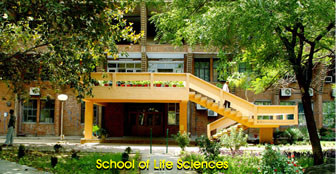
School of Life Sciences

The School of Life Sciences (SLS) at JNU was established in 1970-71, making it the first Science School in the University. It was founded based on a concept paper developed by the committee headed by Prof. M.S. Swaminathan and was the country's first school dedicated to teaching and research in life sciences. SLS focuses on interdisciplinary Life Sciences teaching and research from the molecular to organismal levels. It encompasses diverse research areas, from biochemistry to genetics, studying various organisms. SLS is renowned for its integrative M.Sc. teaching program, offering remedial courses to accommodate students from diverse science backgrounds. It regularly updates academic programs, integrates emerging areas into research and teaching, and provides well-equipped practical laboratories for hands-on training in theory subjects. SLS offers a Ph.D. program with five research thematic groups, spanning disciplines from molecules to organisms and diseases. Ph.D. students carry out research in state-of-the-art laboratories. The School consistently secures extramural funding and has a strong track record of cutting edge research in multidisciplinary areas. The school has produced more than 760 Ph.D. and 1020 M.Sc. graduates and remains an attractive destination for life science studies and research.


Research and Activities
Quality teaching requires ongoing research activities which needs a good deal of financial support. While it is our national mandate to provide training of the highest quality of life sciences, university system due to its own constraints, provides little intramural support for the research programmes.
SLS is fortunate to bring in research funds through national and international agencies in the form of research projects.
National funding agencies like Department of Bio-Technology, Council of Scientific & Industrial Research, Indian Council for Agricultural Research, Indian Council for Medical Research, Department of Science & Technology, Defence & Ordinance Department, Department of Atomic Energy also DAAD etc. and even international agencies like WHO, USDA, European Commission, German Indo-French, Indo-US and host of others have generously supported the ongoing research of the School.
The School has through various research grants, obtained a cumulative sum of about Rs. 17 crores, for its ongoing research activities. But for the research project funding obtained by the SLS faculty, it would have been impossible to run our research training programmes.
Research projects thus not only enable the faculty members in running their research programmes, but also enable the students to take challenging and modern research topics for their M.Phil. and Ph.D. thesis.
Students trained at SLS are in demand. Almost all the students completing Ph.D. degrees from SLS(285 till date), get opportunities for post-doctoral work abroad, and a great many return to serve the country .
School's faculty and students publish extensively in reputed national and international journals. To date, SLS has to its credit, over 2000 research publications.
These research efforts have resulted in numerous awards, honours and recognitions to the students and the faculty of SLS.
There are three Bhatnagar Awardees, four fellows of the Indian National Science Academy, four fellows of the Indian Academy of Sciences and six fellows of the National Academy of Sciences within the SLS faculty. First international patent from India (AmA I) was obtained from SLS. Several other patents are in the pipeline including one for a very sensitive immunodiagnostic method for detecting tuberculosis antigens.
 
Collaborations
Since SLS has faculty with expertise in all major areas of Modern Biology, School's faculty is very often called upon to teach in other Universities.
The School has also extended support and help in developing teaching programmes and organizing refresher courses in other Universities.
The faculty of the School plays important roles in University Grants Commission/Council of Scientific & Industrial Research (CSIR), National testing for NET examinations/research fellowships for RAs, JRFs and pool officers.
Our faculty members also serve on a vast array of national committees and task forces. Two SLS faculty members (Prof. P.N. Srivastava and Prof. Asis Datta) have occupied the University VC's position and one (Prof. P.N. Srivastava) served as President, Indian National Science Congress. The School provides a pool of experts for governmental agencies like University Grants Commission, Department of Bio-Technology, Department of Science & Technology, Indian Council for Agricultural Research, Indian Council for Medical Research, CSIR, Union Public Service Commission (UPSC), National Council for Educational Research & Training (NCERT) and others.
Several faculty members have worked for the working groups of the Planning Commission, on health, education and biotechnology and members on state councils. The School also provides research supports to the students, teachers and researchers from other state university by allowing them to use its CIF facility. The School therefore, serves as a catalyst in the vital scientific and educational activities of India and has commitment to continue its service for the nation.
The School has link-research activities with other institutes in the country, like Nuclear Science Centre (NSC), National Institute of Immunology (NII), All India Institute of Medical Sciences (AIIMS), Centre for Cellular and Molecular Biology (CCMB), Tata Institute for Fundamental Research (TIFR), Institute for Nuclear Medicine and Applied Sciences (INMAS), Bhabha Atomic Research Centre (BARC), International Centre for Genetic Engineering & Biotechnology (ICGEB) etc. and several other universities. The School is also the nodal affiliating body for CCMB, Hyderabad and NII, New Delhi. Most faculty members have collaborative research programmes with institutions in Germany, France, Russia, Poland, USA, Israel and several other national and international institutions.